


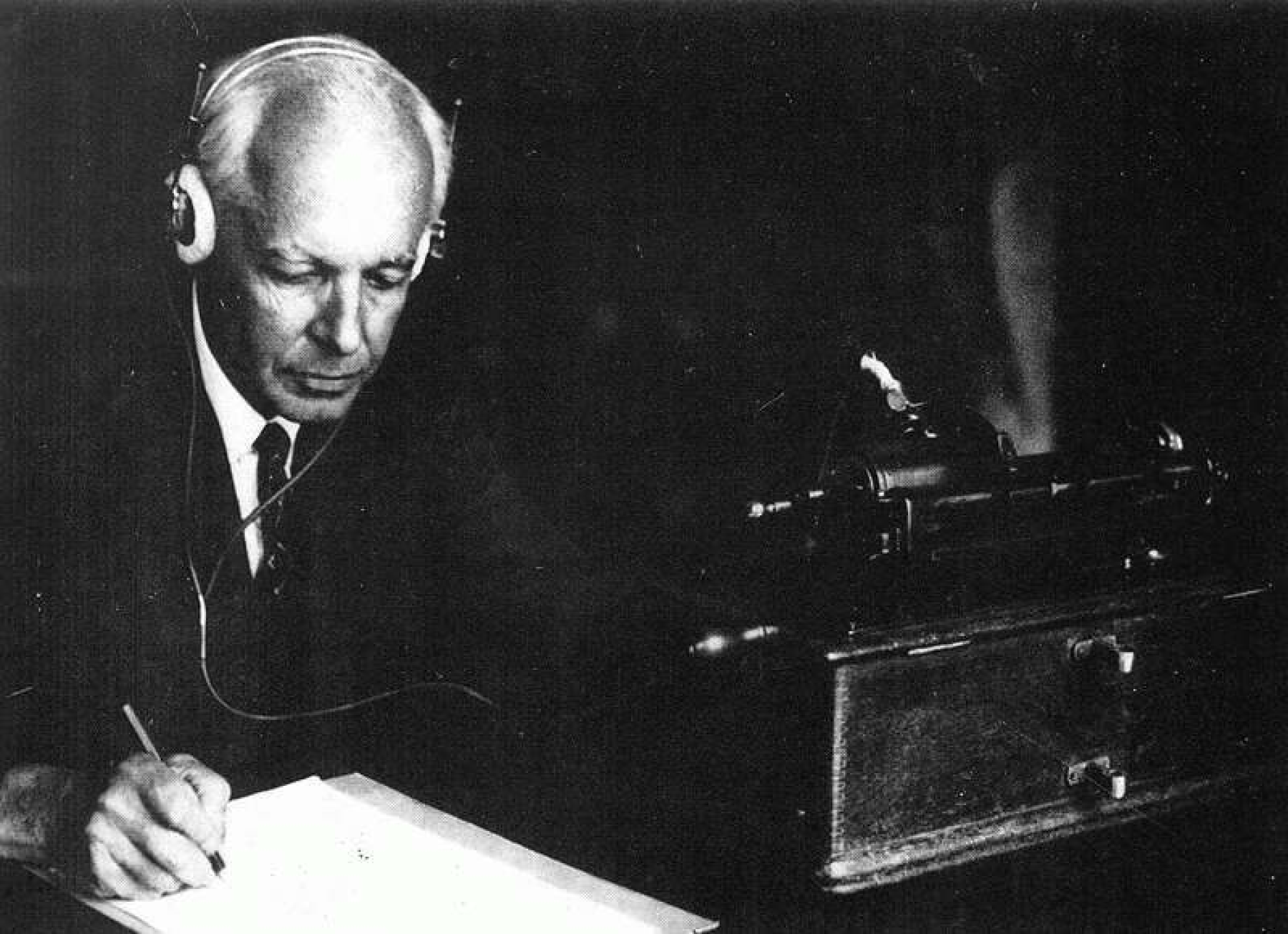
Who hasn’t dreamed of stepping out of their comfort zone to discover new lands and new cultures? While Béla Bartók’s motivations were far more complex, and he didn’t even have to visit exotic islands to make great discoveries, the music he collected on his expeditions fundamentally changed his own time and the future.
Those who follow the experimental music scene are no strangers to the phenomenon of composers putting away their instruments and setting out with a single microphone. What sounds can be heard inside a bouncing rubber ball? What rustles in the hollow trunk of a tree that has become home to other life forms? What happens under the ice of a frozen river? It is easy to find the original motivation behind these questions and the thousands of others that merit a search on YouTube: it is to find inspiration as one turns one’s back on familiar musical forms and the often unwanted assault of countless earworms.
These examples may prove not all that far removed when we attempt to look at the intricacies of Bartók’s work as a collector of music. The young composer began to chart the inexhaustible sources of folk music in 1906, and the timing was auspicious as Hungarian composers at the time scarcely offered anything new to the young generation with their completely hackneyed elements of the verbunkos (recruiting dance) style.
Technological development was another important motivator: with Edison’s invention of the phonograph in 1877, it became possible to record sound, and Bartók quickly realized that a notebook would not be enough for collection purposes. The performers played as important a role in the exploration of authentic folk culture as the performance itself, and the reproduction of the sound material made it possible to juxtapose, in a way simpler than ever before, motifs and musical universes that seem geographically distant, yet have common roots deep down.
Thirdly, these were the last peaceful years of peasant culture – although this was something that Bartók could only have an inkling of at the turn of the 19th and 20th centuries. “Peaceful,” of course, deserves to be put in inverted commas because suffering and defencelessness always cast a dark shadow over the “pure source,” as Bartók himself experienced at first hand. Over the decades that followed, the mechanization of agriculture, the forced redistribution of arable land and intensifying urbanization radically transformed the world that Bartók could still see more or less untouched when he travelled around the country and neighbouring areas in 1906. Surviving recordings and other sources show that a great many of those who performed for him were young people, which would have been inconceivable a few decades later.
 Photo: Csibi Szilvia, Müpa
The result is well known: the greatest Hungarian composer, who fundamentally rewrote the music of his time and of the future, made more than 10,000 recordings in the field, thus creating a radically new attitude in national, regional and even Turkish culture.
However, Bartók’s curiosity and passion for organization were not driven solely by music. His restless interest in other cultures also seems to have been motivated by his love of precision. While he studied the universal language of music, he also learned Romanian, Slovak, Spanish and Turkish, to add to his knowledge of English, German, French and Italian.
And if all this seems to be in line with Bartók’s passion for work, we must also remember his insect collection, the surviving part of which is still prized by researchers – while the rest was destroyed when he emigrated and during the war. By the 1920s, he had mounted and identified 30 to 40 large cigar boxes’ worth of specimens. Of this little-known passion, Bartók said: “Songs have been collected solely as distinct objects. But that is not enough. Because that would be comparable to an entomologist or lepidopterist being satisfied with gathering and preparing different kinds of insects or butterflies. But if he were satisfied with that, his collection would be dead material torn from life. That is why a true natural scientist would not only collect and prepare animals but would study and describe, as far as possible, all the most hidden moments of animal life. While it is true that the most detailed description will not instil the dead with life, he will nonetheless save some of the flavour and odour of life in that dead collection. The same reasons command the collector of folk music to thoroughly investigate the circumstances of the life of every melody.”