

'He walked like a tiger. Instead of transferring the inactive burden from one position to another, he had some elastic relationship with weight, like an eagle does with air...' Paul Claudel was not the only one at the beginning of the 20th century to speak in superlatives about the greatest dancer of the period, Vaslav Nijinsky.
The private person, the dancer, the choreographer: three roles, but many more than three masks, constantly playing into each other, although apparently separable. Astonishingly, Vaslav Fomich Nijinsky, who died in London in 1950 at the age of sixty-one, had an active career that spanned barely a decade at the beginning of the last century. And yet, his works remain a reference and source of inspiration long after his death. While Nijinsky was the revolutionary father of modern dance, and of the genres that sprang from it, his biography and legacy hold some disturbing lessons.
Born in Kyiv to Polish ballet-dancing parents, Nijinsky’s exceptional talents were evident from an early age. Tamara Karsavina, a brilliant ballerina who later often partnered him on stage, first saw him at ballet school: “I could not believe my eyes; one boy in a leap rose far above the heads of the others and seemed to tarry in the air. ‘Who is this?’ I asked Michael Obouchoff, his master. ‘It is Nijinsky; the little devil never comes down with the music’.”
His contemporaries agreed that Nijinsky’s physique and temperament were a far cry from those of the traditional male dancer. Some people were incredulous at his performance: in her memoirs, his later wife Romola de Pulszky tells of an impresario in London who asked for Nijinsky’s shoes, “to see whether or not they had rubber soles. Many others inspected the stage for traps or other mechanical contrivances.”
In order for his mysterious stage persona to unfold in its fullness, Nijinsky had to meet a key figure in the Russian art world, Sergei Diaghilev. In one of his writings, the artistic director of the Ballets Russes, which quickly became legendary, described himself as a charlatan, a charmer and a brazen fellow, whose forte was patronage. In her memoir, Karsavina places the emphasis elsewhere: “There is no toxin of sentimentality in Diaghilev. Not only does he not regret yesterday, but all his mental attitude tends towards tomorrow.”
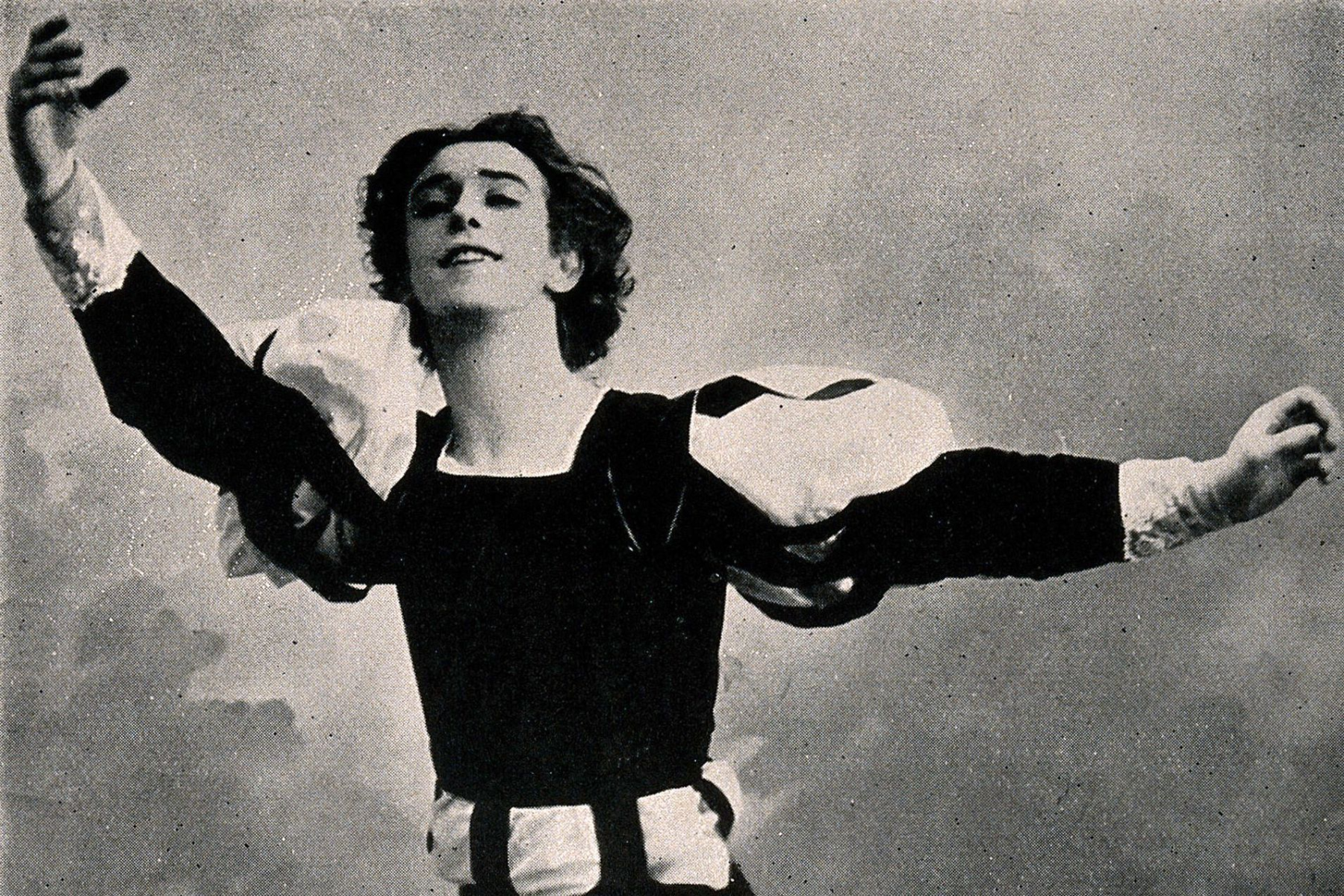
Everything is connected: all these qualities and traits must have attracted Nijinsky, an eccentric himself. When the brilliant dancer had to leave the Mariinsky Theatre because of the scandal caused by his costume in Giselle – which would be unlikely to raise eyebrows today – a new chapter began with the birth of Nijinsky, the choreographer.
To understand the puzzled, enthusiastic or even furious reactions to his works, it is worth recalling the words of dance historian Lívia Fuchs, who says that Nijinsky “always staged subjects for which he did not have the appropriate dance vocabulary, so he had to find and invent new forms of movement on his own.” Recollections of his rehearsals confirm that while Nijinsky did not really know what he was doing with the genre of ballet or with dancers accustomed to a very different dance language, his stubbornness and willpower helped him to overcome practical difficulties.
Based on Mallarmé’s poem and performed to music by Debussy, The Afternoon of a Faun, which premièred in Paris in 1912, became one of the most polarizing works in dance history. “The audience sat motionless during the twelve minutes of this choreographic poem,” wrote Romola de Pulszky. “They were so taken back, so surprised, that they gave no sign whatsoever. But as soon as the curtain fell, the most incredible uproar occurred.” Debussy was rumoured to have only asked: “Why?” Instead of a well-argued review, the next day an editorial condemned the work for being overly sexualized and representing animal eroticism, but no less an artist came to Nijinsky’s defence than the celebrated sculptor Auguste Rodin.
His next choreography, the 1913 production Jeux (Games), also adopted a framework that was surprising in the strictly regulated world of classical ballet: with their movements, young people flirting at a tennis match turned sport into a subject for dance theatre. The world première of Stravinsky’s The Rite of Spring also baffled its audience with music that many found to be merely “noise,” and with choreography by Nijinsky using a vocabulary they considered “primitive.”
It was around this time in Nijinsky’s life, which would soon be cast into darkness, that the Hungarian thread became important. Romola de Pulszky, the daughter of Emília Márkus, a celebrated actress of the time, managed to get close to the dancer and – to the surprise of his immediate entourage – even got him to marry her. This led to the end of the private and professional relationship between Nijinsky and Diaghilev.
Choreographing Till Eulenspiegel in the United States in 1916 could have offered Nijinsky a release from the oppressive burden of the First World War and his house arrest in Budapest, where he was classified as an “enemy Russian citizen,” but the reception was at best polite. As the war was nearing its end, Nijinsky’s always fragile mind broke, and he spent the last three and a half decades of his life at the gates or very depths of madness.
His diary, edited by his wife and published in several versions, is a sad and disturbing read – perhaps not even for the world to see. Published in Hungarian most recently in 1997 as Füzetek (Notebooks), this bizarre torrent of text is at best a psychological curiosity, but by no means a key to the personality of a legend of 20th-century dance. There are, of course, occasional flashes of light in the series of night-black thoughts, but you cannot shake off the feeling that you’re getting a glimpse of something you should not have seen.
Other things should be seen, however, such as the photographs taken at Nijinsky’s performances, which have intrigued historians, critics and philosophers for decades. In 1943, American poet Edwin Denby offered a pithy summary of his impressions of the dancer based on these photographs: “He is never showing you himself, or an interpretation of himself. He is never vain of what he is showing you. The audience does not see him as a professional dancer, or as a professional charmer. He disappears completely, and instead there is an imaginary being in his place. Like a classic artist, he remains detached, unseen, unmoved, uninterested.”
The article was originally published in Bartók Spring Magazine's 2026. edition
Lead photo: Nijiskiy in Giselle / Wellcome Collection