

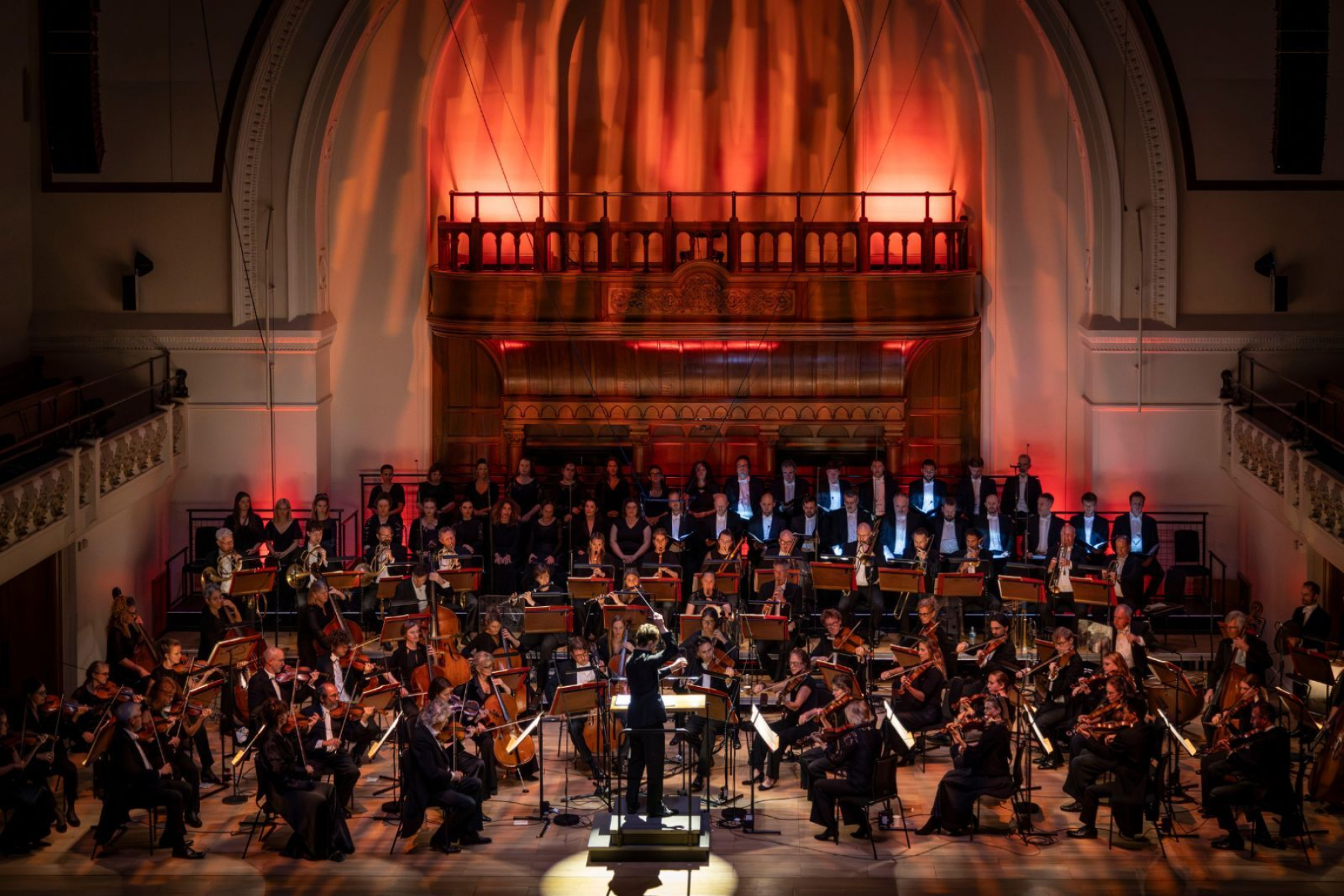
Perhaps only Christmas has a richer musical heritage than Easter: it is both a celebration of contemplation and the resurrection of Christ, as well as a sign of the arrival of spring. Along with the classics—Bach’s Passions, the symphonies of Haydn and Mahler and an oratorio by Liszt—we would now like to recommend some rarities.
In 1886, Pyotr Tchaikovsky wrote this to his brother, Modest, about the festival, which he had spent in Tbilisi: ‘I spent the days of Easter visiting churches: Russian, Armenian, Georgian. The local metropolitan, Pavel, is very helpful. I heard the matins in the Sioni Cathedral, which is solemn, majestic, like a palace. There has been an endless succession of celebrations since then, some at home, some at other people’s.’
The compositions that are associated with this period make a long list, but we should probably start with Bach’s St Matthew Passion and St John Passion. Bach also composed an Easter Oratorio during his Leipzig years, almost a sequel to the Passions, themed on the miracle of the empty grave, the resurrection of the Saviour. It is so much more serene that Bach even composed a parody of it for the Saxe-Weissenfels court.
Although Handel’s Messiah oratorio has in recent decades been regularly included in the Christmas concert programmes in English-speaking countries, it is more of a work for Easter. Composed in just three weeks, it was performed at several charity concerts in Handel’s own lifetime. Mozart later wrote a rearranged version.
From Maundy Thursday to Easter Monday
Many of the masterpieces of church music were written by the composers of the papal court. Perhaps the most famous of these is Miserere, a choral work by Gregorio Allegri (1582–1652), which was often performed in the Holy Week and gained notoriety when the Pope banned its performance outside the Vatican. The young Mozart was also captivated by this hypnotic piece, which is based on Psalm 51; anecdotally, he wrote it down from memory after hearing it once.
Similarly commissioned by the Vatican, Palestrina wrote moving, majestic, but never monotonous, pieces. Improperia (the remonstrances of Christ with the people) is a choral piece that has been part of the Holy Week services since Pope Paul IV.
Much of Antonio Vivaldi’s oeuvre was rediscovered in the 20th century. These works include Stabat Mater, a favourite for the Easter programmes of amateur and professional choirs alike. It was raised from centuries of silence when it was discovered in the Royal Library of Turin and was performed in 1939.
Although the Easter repertoire is dominated by oratorial works, let us not forget about Heinrich Ignaz Franz Biber’s Rosary Sonatas, which came to the attention of modern musicologists in 1905. From the sixth movement onwards, the scenes that are presented are the agony of Christ in the Garden of Gethsemane, the scourging at the pillar, the stations of the cross, the crucifixion and the resurrection.
And when it comes to instrumental pieces, there is also Haydn’s The Seven Last Words of Christ, originally written for orchestra and later reworked for string quartet, as well as for orchestra, choir and vocal soloists. It is often performed in churches, accompanying a sermon or verse recitation. Haydn also wrote a stirring symphony on the subject, La passione.
Die letzten Leiden des Erlösers (The Last Sufferings of the Saviour), which Carl Philipp Emanuel Bach, Johann Sebastian’s most famous son, wrote as the Kapellmeister in Hamburg (where he was the successor of Telemann), is a hidden gem. It was a moving and rousing piece for a church that was attended by the inmates of a poorhouse and a prison, whose attention was likely to wander off.
Romantic Masters
The French Hector Berlioz was merely twenty years old when he composed Messe solennelle—a dazzlingly modern piece from the year when Symphony No. 9 was premiered. In it, Resurrexit is one of the most powerful representations of the subject.
The 19th-century rediscovery of Bach’s St Matthew Passion ushered in a vogue for large-scale oratorios. Franz Liszt’s Christus includes an arrangement of O filii et filiae, an Easter hymn.
Mahler’s Symphony No. 2, known as the Resurrection Symphony, lies outside the tradition of church music. Although it conveys religious rapture and deals with the great questions of life, it is not inspired by a belief in God, but by poems that explore mortality and the possibility of an afterlife.
Ralph Vaughan Williams’ Five Mystical Songs for baritone solo and orchestra is a little-known piece that is rarely performed. Its Easter movement is about the news of resurrection.
Contemporary Masterpieces
Arvo Pärt’s 1982 St John Passion is a setting of Latin gospel texts and is perhaps the most beautiful of contemporary Passions. The composer, who had just emigrated to Austria and was finding his mature voice, was inspired not so much by Bach as medieval monophonic choral works. The cry of the crowd as they demand that Christ be crucified is particularly stirring: ‘Crucifige eum!’
John Tavener’s Lament of the Mother of God is a modern classic, a choral piece that evokes the meditative sound of Orthodox church music. It is astonishing, moving music that deserves to be listened to attentively.