

Dolce Vita: It takes courage to stage an exhibition with this title because it cannot but bring to mind the film on nightlife in Rome at the end of the 1950s: the bars on Via Veneto, the house parties – and the ambivalence of the fake glamour, becoming cloyed with all the sweets, although everyone will tend to remember only the intoxication of Anita Ekberg and Marcello Mastroianni kissing in the Trevi Fountain. How could you, in other words, satisfy the desires aroused by the expression sweet life with dead objects, paintings and sculptures?
Life in Italy was probably sweeter in Fellini’s time, and remains sweeter today than anywhere else in the world: the fantastic geographical diversity of the Mediterranean is matched by the incredible density of monuments per square kilometre, many of which are still in use, the temperament of the people, the food… It’s probably pointless to go on with the list of commonplaces, true as they are, but if we did, we’d end up with another film, La Grande Bellezza (The Great Beauty), and a stacking of cultural layers of unmatched richness. It is this which has provided Hungarian art – itself comparatively very young, barely two hundred years old – with inspiration like no other.
István Ferenczy’s 1822 sculpture of a shepherdess, A szép mesterségek kezdete (The Beginning of Fine Arts), is considered the first manifestation of the Italian influence on Hungarian art. Then came Károly Markó, for years a professor of the Florence Academy of Fine Arts, and his children, both sons and daughters, who long supplied the Hungarian market with paintings of Italian landscapes, classical ruins and mythological scenes, serving as models for later Hungarian landscapists.
Even when this influence, which had set academic standards and long dominated art education in this country, began to fade, Italy and its classical heritage continued to attract painters. The best example of this is Archaeology, an 1896 study for an unrealized fresco by Károly Ferenczy – no relation to István above – which captured the experiences of a study trip to Italy and became one of the most beautiful reminders of Hungarian Art Nouveau’s longing for other landscapes and more ancient times.
But while we’re still dealing with only the monuments, i.e. dead things, when will sweet life make its appearance?
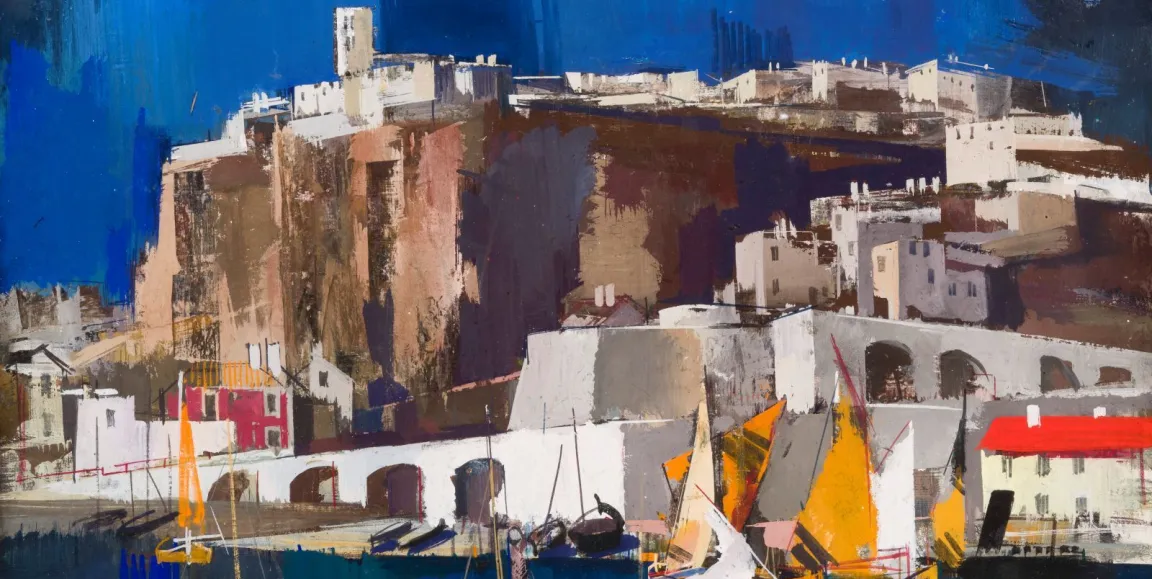
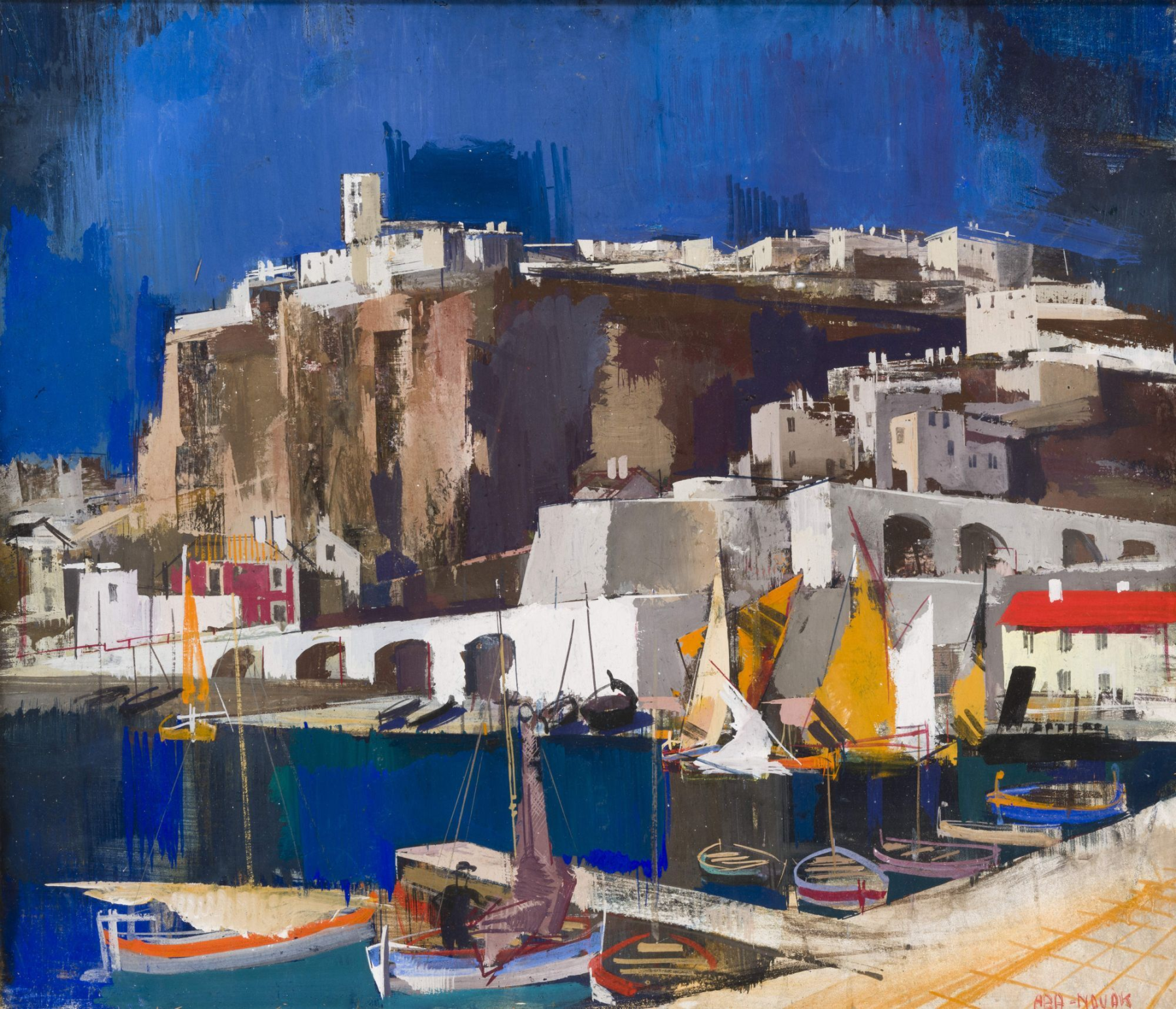
Interestingly, it was an art historian, Professor Tibor Gerevich, who made the enjoyment of Italian life almost compulsory for would-be artists, young painters and sculptors. Thanks to him, the Collegium Hungaricum (Hungarian Academy) took up residence in a very prestigious neighbourhood in Rome, in one of the most beautiful Baroque palaces on the Via Giulia, by the river Tiber. From 1928, artists who won a scholarship to Rome could spend months here or use it as a “base” for travels around Italy. In Hungarian art history, works by these scholarship holders, who followed Italian models under the spell of Italy’s landscapes and the life they lived there, are considered as products of the Roman School. They include a group portrait of fellow painters on the terrace of the palace that overlooks the river, a group of attractive boys and girls enjoying life and each other’s company, though the subjects and scenes they would paint varied widely, from locals making merry in trattorias and taverns, through showmen who seem to have stepped out of Pagliacci, to harbour scenes and small towns during siesta or the bustle of the night.
What the Italian experience meant for young artists is captured perhaps most successfully in a painting made after the war, when the scholarship continued to be offered. Especially after 1945 and until the fall of the Iron Curtain, it is very much a celebration of the chance to leave behind an increasingly oppressive Hungarian milieu. It is quite a special composition, no longer in the style of the Roman School, and its subject matter is also more modern, featuring three young people riding in the back of a flat-bed truck, gazing up at the night sky, gliding through the beautiful Italian scenery. That is, at least, what the picture suggests: the feeling of gliding under the Italian sky, when in reality they were being slowly jolted along. Their heads look as if they had rolled off some antique sarcophagi or the tombs along the Via Appia. Judit Reigl told me that there were no tourists immediately after the war, and Rome was almost empty. Although Rome had declared itself an open city to avoid the destruction of its population and built heritage, surrendering to the advancing enemy without a fight, it had been bombed before its capture, causing artefacts to be unearthed. Reigl herself found the head of an antique sculpture, which she sold to an American, using the proceeds to buy train tickets.
By the way, if ten years ago you had cast your eyes from the roof terrace of the Hungarian Academy – designed by Borromini and decorated with Janus heads – to the opposite bank of the Tiber, you would have seen a wondrous sight. William Kentridge, an artist also known as a set designer and director of opera, covered 550 metres of the stone wall of the embankment with stencils and cleaned the uncovered parts in between with a high-pressure water jet. When the stencils were removed, what was left of the black deposit of exhaust fumes and other dirt was the work itself, a procession on the model of Trajan’s Column, with figures from the history of Rome passing before our eyes. It also featured the most famous scene from La Dolce Vita, the one at the Trevi Fountain. Fellini, who directed Ekberg and Mastroianni in a hat, coat and scarf in the Roman winter, was not included; we only have on-set stills to show what sometimes lies behind the sweet life.
As the Roman School gained currency in Hungarian painting as a trend in the vein of the classical tradition, even artists who subscribed to the more modern, French idiom of painting were likewise not left untouched by everything that Italy meant. János Vaszary was a case in point. A respectable academy professor, the nephew of Archbishop Kolos Vaszary and a former war painter, he was also curious about modern life. With pure colours applied with an economy of virtuosic brushstrokes, his canvases bustle with parasols, bathrobes, sails, the striped shirts of sailors, palm trees and cocktails with straws. Nor will his seaside scenes ever go out of fashion: the healthy tans, bathing suits and parasols look much the same today as they did one hundred years ago.
“Today I Didn't Go To The Beach Either,” is the phrase Emese Benczúr embroidered on the striped canvas of deckchairs hundreds of times. The artist, who makes invisible domestic work visible, is also the creator of the title piece of the National Gallery’s exhibition. The work, sized 300 × 180 cm, is composed of shiny, colourful sweet wrappers; some, however, face the viewer with their uninteresting, plain insides, making up the inscription, Dolce Vita.
Two answers may be proposed to our initial question; namely, how the sweetness of life can be experienced in a museum. One is that, for some, this is the good life itself: looking at works of art, unwrapping what they have inside. The other is longing for the things the images evoke. There’s nothing sweeter than looking back to better days. Or is this not the case? Be that as it may, whether you have been to Italy or are planning to go, life is sweet.
The article was originally published in Bartók Spring Magazine's 2026 edition.
Lead photo: Aba-Novák Vilmos: Kikötő