

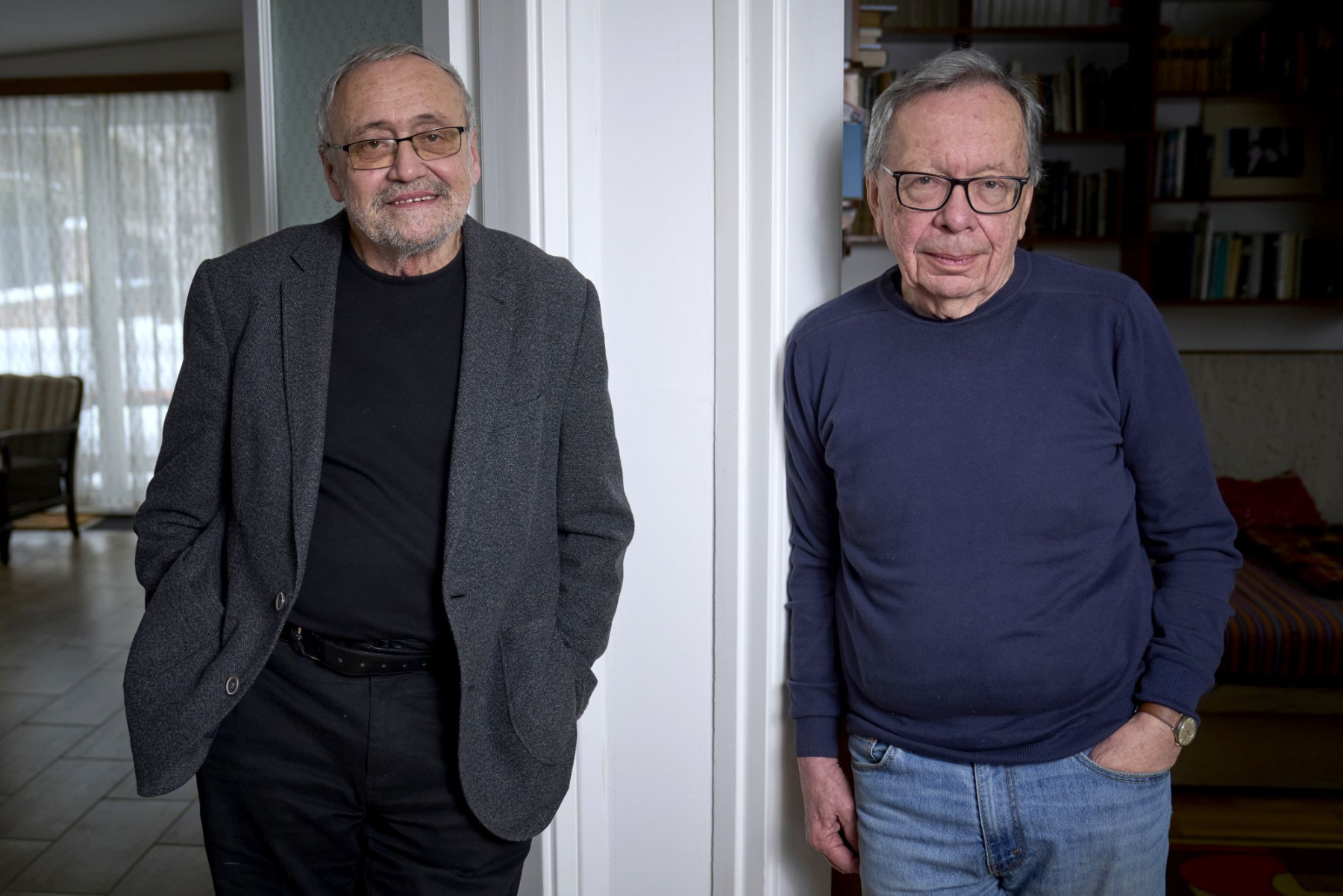
Two composers, whose professional relationship is “unconventional,” and who are also close friends. For decades, György Selmeczi and János Vajda – together with György Orbán and Miklós Csemiczky, who passed away recently – have been referred to as The Four, an association they themselves have come to accept, even though their musical languages are different in many respects. They share a house in Kisoroszi and regularly cook together, but when I ask them who is the better cook, their indignant response is that it’s like asking them who is the better composer. At this year’s Bartók Spring, their two one-act operas will be premièred on the same evening.
When you were young, you showed all your works to each other, and you continue to work together a lot. Do you remember any important advice or criticism that you’ve found helpful?
György Selmeczi: There must have been some. What connects us is a professional relationship that is completely unconventional. We recently had a Lied recital we call The Four and ritualistically hold every year. It was at this concert that I realized how different we four are. It’s undoubtedly true that our ideals connect us in a way, but stylistically and linguistically, each of us sticks to his guns, which ideally results in a style of one’s own.
János Vajda: Friendship between four people is a nuanced system of relationships. The two Gyuris – Orbán and Selmeczi – bond over their Transylvanian roots, while Miklós had attachments to Upper Hungary. When we were young, we spent a lot of time together, went to workshops together, where we all jostled for the one upright piano. When we were together like that, we would fool each other – and I don’t mean that only figuratively – so we would all run our mouths, which naturally had an effect on the others.
What is that shared basis of ideals you mentioned?
J. V.: To write music you can listen to – music that brings joy not only to us, but also to others listening to it. To return to a certain kind of music took a certain kind of courage forty years ago; it did not seem comme il faut and fashionable. And it also set us apart from most of our colleagues. Of course, there were other things as well that caused these four people to go in directions other than the mainstream, but the reasons are no longer important.
Gy. S.: All the more so because, interestingly, we’ve been proven somewhat right in the decision we made in the mid-1980s to go against the neo-avant-garde form of expression that was all but mandated by the pundits of the time. By the time we all decided, at different times, to refuse to abide by this and try to find our way back to the listeners – and more than that; try to find our way back to the performers – the world had become so extreme that even the performers were looking askance at the scores contemporary composers put in front of them. Although in the 1990s we were still considered eccentrics, the fact that we were proven right to some extent has also settled any sharp conflicts we may have had with composer colleagues.
J. V.: Our situation is different in that Gyuri Selmeczi is the only one among the four of us who is also an active performer, so he is confronted with the opinions of performers on a daily basis. If it’s not exactly an ivory tower, composers still live more secluded lives, and what they hear are usually not the performer’s first impressions, but their more sophisticated insights.
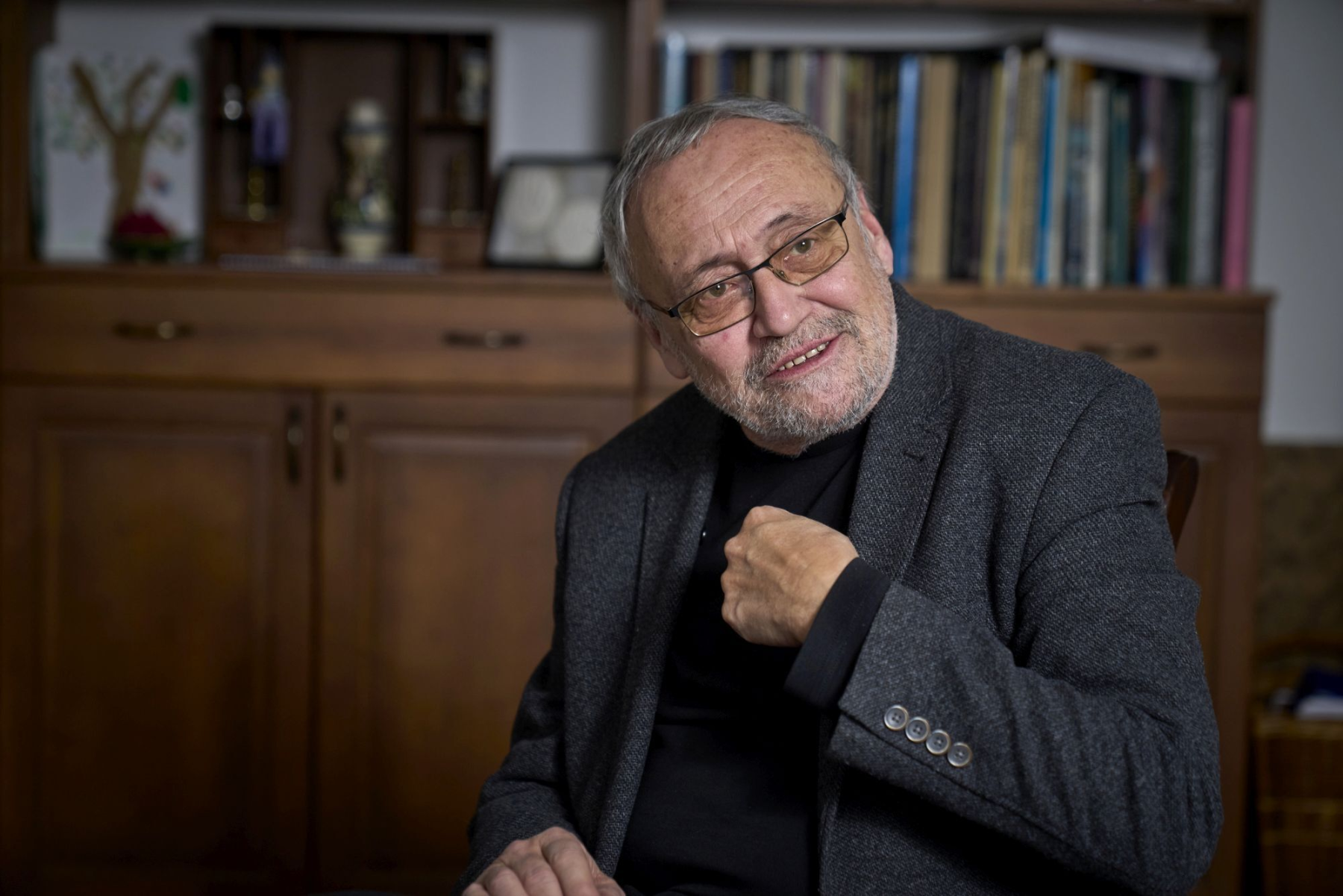 György Selmeczi © Gábor Valuska
Where are the boundaries of a friendship drawn? Do you prefer to fully support each other’s ideas, or to be frank and critical when necessary, painful as it may be?
J. V.: As far as the human factor is concerned, patience, support and understanding are certainly the way to go. As for the professional side of it, our behaviour has changed a lot over the decades. And we are all different characters. I have scores that Gyuri Orbán scribbled all over. He didn’t hold back, to put it mildly. Miklós acted similarly. I think we two are more permissive than that, and we try to see the good even in the bad.
Gy. S.: That’s right, and there is another overriding aspect as well: a kind of elegance that we insist on. If you’ve lived long enough, you will have put sufficient work into this elegance.
This was probably not the case when you were jostling by the upright piano.
Gy. S.: Something like this was at work even then. To be honest, we always had self-respect in this regard, and we refrained from tasteless or hurtful remarks.
J. V.: After Miklós died, he turned out to have reviewed a work of mine, now deservedly forgotten, and it was an utterly insightful and elegant piece of writing. It was incredibly entertaining, while it made you apoplectic. But I had to give credit where credit was due.
Do you compete with each other, however playfully? I remember you, János, citing such a motivation when you wrote your first piano concerto.
J. V.: Vanity was indeed part of it. Miklós kept saying that Orbán should write a piano concerto, and at one point I got so worked up that I took it upon myself to write one. Since I can’t play the piano, I at least took more liberties with the material.
Gy. S.: We have a photo in which János is conducting one of my pieces of film music in the once famous Lumumba Street studio. I was standing there by the rostrum, with Orbán, who sometimes gave a hand and contributed the odd part. Such collaboration was necessary when I got into trouble with a missed deadline. Orbán, who took part in the orchestration of soundtracks as a “guest artist,” was helping me when we were recording Szerencsés Dániel (Daniel Takes a Train). The Hungarian National Philharmonic Orchestra was there and we had to start rehearsing. We thought we would have rehearsals for the strings only because I hadn’t completed the wind part. Palika Sándor, the director, was already screaming that we should get going, and as it happened, it sounded quite good even that way. The red light went on and the tape started rolling when Gyuri Orbán burst in: “I’ve written a beautiful horn counterpoint!”
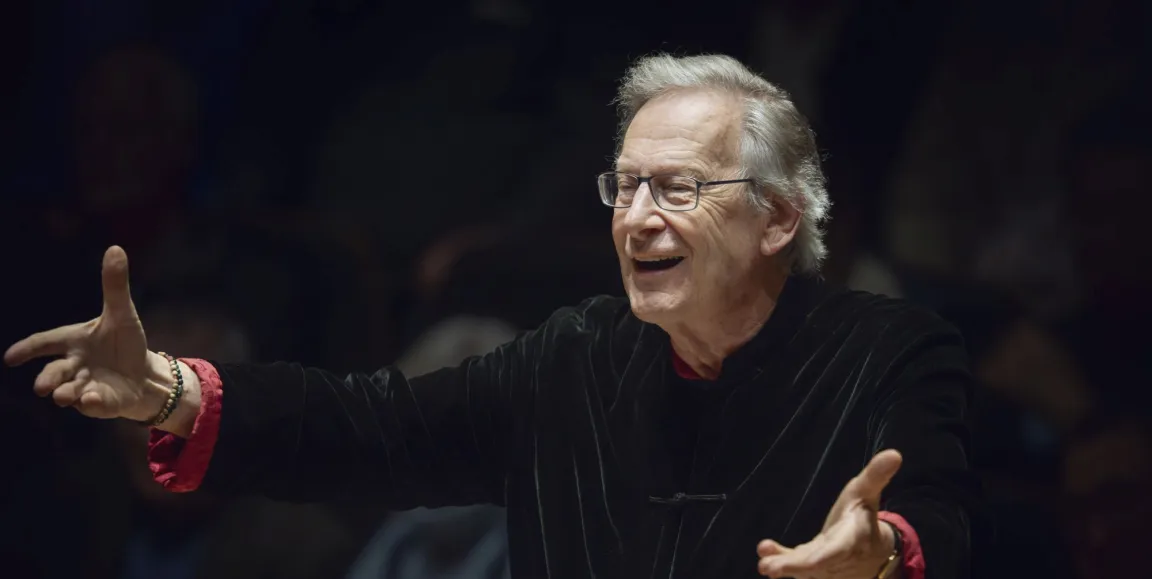
 János Vajda © Gábor Valuska
Kodály said of Bartók that he always avoided competing with him, he always tried to do something different. Is that something you seek to do?
Gy. S.: No, we don’t, and, in fact, we’ve always pounced on each other’s hunting grounds with great appetite.
J. V.: To the extent of quoting each other. I have a choral work where I realized it was Orbán through and through; I wrote as much in the score. Selmeczi also told me what I had taken from him. You can absolutely do these things.
How did the genre of opera become important? Earlier you said it was a chance meeting.
J. V.: For me, it was; but Gyuri grew up in the theatre, so it was easy for him. As for me, it began with a youthful commission. To exaggerate a bit, I wrote my first opera before seeing one. So it was beginner’s luck and I fell in love with the genre. I find writing opera very, very entertaining.
Did music for the stage come to you entirely as a matter of course, Gyuri?
Gy. S.: No, it wasn’t a matter of course, and I’d say I would likely never have written an opera if it hadn’t been for János. He’s been a model for me since Mario and the Magician; I’ve had the privilege of conducting several premières of his works. He is the one I consider an opera composer, although, of course, my own inspiration was, in a sense, a matter of destiny. My father was an opera conductor, but I also had to find a way to be a valid opera composer. The courageous and open-minded programming policy of the Cluj-Napoca [Kolozsvár] Hungarian Opera played a major role in the careers of both of us – and of many of our contemporaries – by allowing these works to be staged. Back in the 1980s, I still wanted to be very unconventional, and so I did not find joy in it. I have since realized that if you’re going to write an opera, you have to acknowledge the operatic tradition.
The interview was originally published in Bartók Spring Magazine's 2026 issue.
Photos: Gábor Valuska, Müpa